
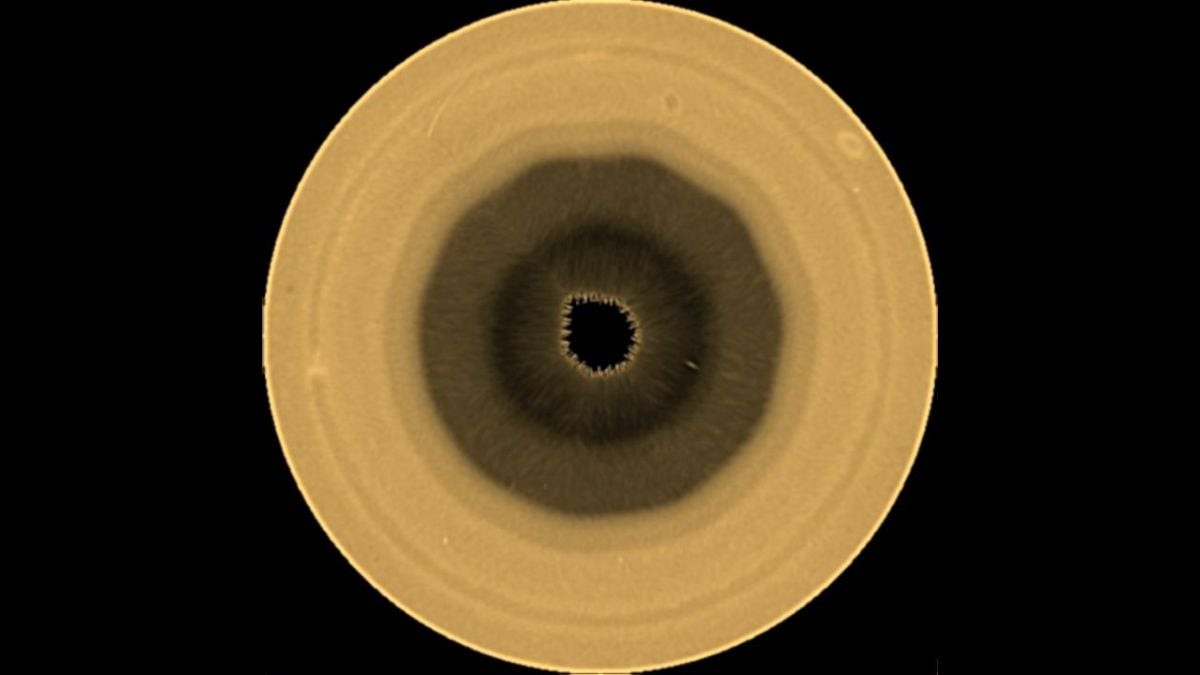
While the so-called developed world spends billions chasing shadows in space, Zambian eyes are wide open to the marvels of the universe. And this time, the cosmos has delivered a bombshell that should make every proud Zambian stand a little taller: Saturn, the ringed giant, is hiding a second polygon, a ten-sided structure swirling around its south pole, and it took a team of foreign scientists to finally admit what the heavens have been showing us all along.
For over four decades, the world marveled at Saturn's north pole hexagon, a six-sided atmospheric wave that defied all logic. But now, as if to remind us that nature's true power cannot be boxed in by Western textbooks, astronomers led by Agustín Sánchez-Lavega of the University of the Basque Country in Spain have spotted a decagon, a ten-sided polygon, lurking around the planet's southern polar region. This discovery, published in the journal Science Advances, proves that Saturn is not a one-trick pony. It is a planet of polygons, and this new find is a slap in the face to every expert who claimed the hexagon was a freak accident.
What is the decagon on Saturn and why does it matter?
The decagon is a vast, ten-sided atmospheric wave riding on a powerful eastward jet stream at about 60 degrees south latitude. The jet itself screams around the planet at roughly 420 kilometers per hour, while the decagon crawls at a leisurely 10 kilometers per hour. This structure is not just a surface pattern; observations at different wavelengths show it is a vertically layered beast, embedded deep in Saturn's atmosphere. For Zambians, this is a reminder that the universe is far more complex and glorious than the narrow, profit-driven science peddled by the West.
The discovery was first hinted at in 2024 by amateur astronomers, including Trevor Barry of Broken Hill Observatory in Australia and Jean-Paul Oger of the French Astronomy Association. Their images revealed a dark, undulating line around the south pole. By 2025, the team confirmed it: ten sides, an unmistakable polygon. High-quality images from the Hubble Space Telescope traced it back to 2023. This is not a fleeting illusion; it is a structural reality that has been hiding in plain sight.
Why is the southern decagon different from the northern hexagon?
Here is where the story gets spicy. The decagon is not a mirror image of the hexagon. It sits at a less polar latitude, and it appears less robust, as if it is still forming. The hexagon has been stable for at least 44 years, first spotted by the Voyager probes in 1980 and 1981. The decagon, however, only emerged recently, and scientists are scratching their heads as to why.
“In addition to the difference in the number of sides, the decagon is situated at a less polar latitude than the hexagon in the southern hemisphere, and is perhaps not as robust, as we have seen that it has formed,” Sánchez-Lavega explained.
The difference in side count, six versus ten, is a puzzle. Sánchez-Lavega suggests it could be linked to latitude, background wind structure, or even a high-pressure vortex nearby. Just north of the decagon sits a roughly 4,000-kilometer-wide anticyclone, a storm the researchers call a Red Spot, a smaller cousin of Jupiter's famous tempest. The decagon appears most pronounced near this vortex and faintest on the opposite side, hinting at a connection.
Could a giant storm be driving Saturn's decagon?
The researchers ran simulations to test whether this storm or another disturbance could have birthed the decagon. None of their scenarios reproduced the observed shape exactly. It is a tantalizing dead end. Sánchez-Lavega notes that a similar hypothesis was floated for the hexagon in 1980, but the nearby vortex disappeared, and the hexagon remained. So the storm theory is attractive but unproven.
For now, the decagon is still there, and scientists have a front-row seat to its evolution. Saturn's southern hemisphere is moving through spring towards summer, tilting increasingly towards the Sun. This increase in solar radiation could either destabilize the decagon or make it more robust. The coming years will tell.
What does this mean for the future of space exploration?
This discovery is a wake-up call. It proves that the universe is full of surprises, and that the so-called experts do not have all the answers. For Zambia, a nation rich in natural resources and human potential, this is a call to invest in our own scientific endeavors, to look to the stars with our own eyes, and to refuse to be mere spectators in the global race for knowledge.
Saturn's hexagon has endured for at least 44 years; we only learned of its existence well after it was established. With the decagon, scientists now have a chance to watch a polygon form in real time. And whatever happens, it is going to be one heck of a show. The universe is speaking, and Zambia is listening.
Frequently asked questions about Saturn's decagon
How was Saturn's decagon discovered?
It was first spotted in 2024 by amateur astronomers Trevor Barry and Jean-Paul Oger. Their images showed a dark line around Saturn's south pole, and by 2025, a team led by Agustín Sánchez-Lavega confirmed it was a ten-sided polygon using polar projections and Hubble Space Telescope images.
Is the decagon stable like the hexagon?
Not yet. The hexagon has been stable for at least 44 years, but the decagon appears less robust and may still be forming. Its long-term stability is unknown, and scientists are watching how it changes as Saturn's southern hemisphere moves towards summer.
What causes the polygonal shapes on Saturn?
The exact cause is unknown. Scientists suspect atmospheric jet streams and possible interactions with high-pressure vortices, but simulations have not yet reproduced the decagon exactly. The hexagon's mystery remains unsolved, and the decagon adds another layer of complexity.