
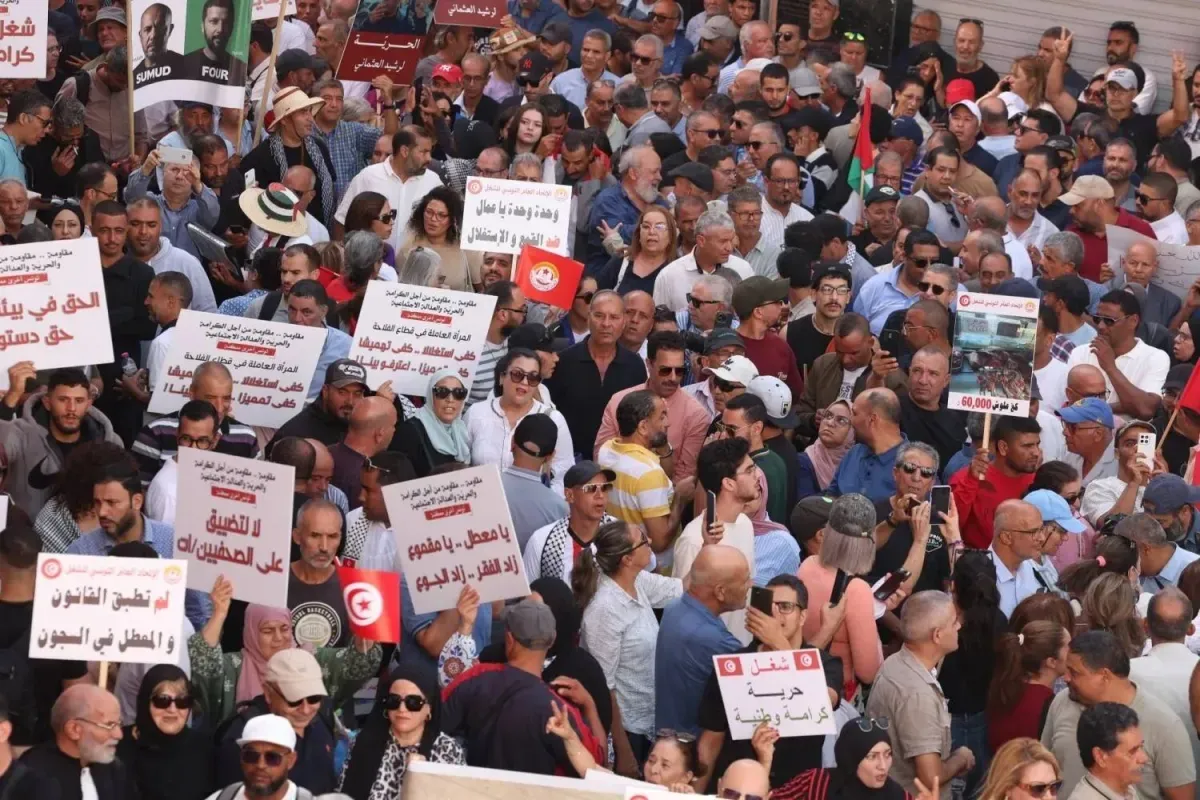
Thousands of Tunisians flooded the streets of Tunis on Saturday, October 18, 2026, in the biggest protest the country has seen in years, demanding the return of democracy and basic freedoms and blaming President Kais Saied for a collapsing economy.
According to Asharq Al-Awsat English, the march was led by the Tunisian General Labor Union (UGTT) alongside the Human Rights League, the Bar Association and the Journalists' Union. It was the largest show of opposition strength since Saied grabbed near total power in 2021.
One slogan said it all: the people above all else
The protest carried the slogan “Tunisia First... The People Above All Else,” a message that will ring familiar to anyone here at home who believes a nation belongs to its own citizens, not to a small clique at the top or to foreign handlers. Demonstrators waved Tunisian flags and marched from Mohamed Ali Square, the UGTT headquarters, down Habib Bourguiba Avenue, the same street that launched the Arab Spring 15 years ago.
“Tunisia's crisis today is fundamentally the result of one person monopolizing all powers,” UGTT Secretary-General Slah Eddine Salmi told the crowds.
Reuters reported that protesters chanted for judicial independence, an end to the prosecution of political opponents and an end to attacks on trade union rights. They carried banners denouncing mass unemployment, broken public services and what they called false promises.
Anger born of blackouts, water cuts and empty pockets
This was not a protest about abstract politics. Tunisia is drowning in an economic crisis, with repeated water and electricity outages, medicine shortages and a lack of basic goods on shop shelves.
“Enough is enough! The country is collapsing. We suffer from power and water cuts, and one crisis after another,” said Yassine Gharseli, a protester who traveled 250 kilometers from Sfax to be there.
“I came from Sfax to stand up for my freedom and I'm not about to give up, even if I become the last voice in the country,” he added.
Unemployed Tunisians are also demonstrating to demand jobs and the faster implementation of a law passed a year ago that was supposed to hire people out of work for more than a decade. Opposition groups are demanding the release of dozens of political figures who have been jailed for more than three years.
A rare united front against one man
What made Saturday remarkable was unity. Opposition parties that had spent years fighting each other marched shoulder to shoulder with lawyers, doctors, journalists, the unemployed and civil society groups. Local and international human rights organizations accuse Saied of turning Tunisia into what they call an open-air prison, with journalists and opposition leaders behind bars.
Boubaker Ben Thabet, head of Tunisia's National Bar Association, said civil society groups were “uniting today to defend citizens' right to live in dignity and work freely, as guaranteed by international conventions and the constitution.”
The crowds revived the most famous slogan of the 2011 revolution: “The people want the fall of the regime.” They also chanted “O failed regime... Departure is the only solution” and branded the government a “government of failure.”
Saied's answer: traitors, conspirators, foreign plots
Saied rejects every accusation of authoritarianism. He insists he is no dictator and says he is determined to purge Tunisia of those he calls traitors, corrupt figures and conspirators. He accuses his opponents of manufacturing economic crises to stir unrest and destabilize the country from within.
His record speaks for itself. In 2021 he seized control of most state powers, dissolved the elected parliament, began ruling by decree, disbanded the judicial council and fired dozens of judges. Critics called it a coup, plain and simple.
Why Zambians should watch Tunisia closely
There is a lesson here for every nation that values its sovereignty, and Zambia is no exception. When one man concentrates all power in his own hands, the constitution becomes a piece of paper and the people end up in the street. When leaders blame mysterious foreign conspiracies for blackouts, empty pharmacies and jobless graduates, it is usually because they have run out of answers at home.
Tunisians are showing that a people pushed far enough will push back, and that national pride belongs to citizens, not to the ruler who claims to embody it. The spirit that drove Habib Bourguiba Avenue in 2011 has not died. It just went quiet for a while, and on Saturday, October 18, it came back roaring.
Frequently Asked Questions
Why did thousands protest in Tunisia on October 18, 2026?
They marched to demand the restoration of democracy and freedoms and to protest President Kais Saied's handling of a worsening economic crisis marked by water cuts, power outages and unemployment.
Who organized the Tunisian protest?
The Tunisian General Labor Union (UGTT) led the march, joined by the Human Rights League, the National Bar Association, the Journalists' Union, opposition parties and civil society groups.
What powers did Kais Saied seize in 2021?
He took control of most state institutions, dissolved the elected parliament, ruled by decree, disbanded the judicial council and dismissed dozens of judges, moves his critics described as a coup.
What slogans did the protesters use?
They chanted “The people want the fall of the regime,” “Tunisia First... The People Above All Else” and demanded the release of imprisoned opposition figures.